Welcome - Seward Glenn Connection PEL Study Online Open House - Public Meeting #6
Comment Period October 21 - November 21, 2025
Welcome and thank you for participating in the sixth Seward to Glenn Connection Planning and Environmental Linkage Study Public Online Open House, hosted by the Alaska Department of Transportation and Public Facilities (DOT&PF) and Anchorage Metropolitan Area Transportation Solutions (AMATS).
Meeting Purpose
The purpose of this online open house is to share the materials that were presented at the Tuesday, October 21, 2025, in-person public meeting, which focused on design alternatives. This online platform is open from October 21 through November 21, 2025.
Feedback
Your feedback is important to us! To provide feedback, you may visit the last section of this Online Open House or visit the website at sewardglennconnection.com.
Meeting Materials
You will also find materials shared at the in-person meeting linked on the project website under the “Project Library” page.
Download a printable PDF version of this Online Open House.
Navigating this site
This site is best experienced on your desktop or laptop computer at 100% view. You may click the tabs in the left navigation panel to visit each poster station. You may click on each poster to enlarge it. To navigate the online open house, please follow the steps listed below:
- Use your mouse to scroll up or down through the open house. You may also choose each poster station in the navigation panel to the left.
- Download additional materials using links within the website.
- Please provide your comments to the project team via the options in the “We Want Your Input” section of this online open house.
If you prefer to experience this online meeting in text format only, visit the “Text Only” page of this meeting.
If you need any additional assistance navigating this open house, please contact info@sewardglennconnection.com or 907-206-2289
Habla español? | Koj hais lus hmoob? | E te tautala samoa?
(907) 206-2289 | info@sewardglennconnection.com

Navigating this Mobile Site
This site is best experienced on your desktop or laptop computer at 100% view. You may access the menu by clicking on the hamburger menu in the top right side of your screen or scroll down to begin.
Please provide your comments to the project team via the options in the “Ways to Comment” section of this online open house.
If you prefer to experience this online meeting in text format only, visit the “Text Only” page of this meeting.
If you need any additional assistance navigating this open house website, please contact info@sewardglennconnection.com or 907-206-2289
Habla español? | Koj hais lus hmoob? | E te tautala samoa?
(907) 206-2289 | info@sewardglennconnection.com
This planning document may be adopted in a subsequent environmental review process in accordance with 23 U.S.C. 168 Integration of Planning and Environmental Review. The environmental review, consultation, and other actions required by applicable Federal environmental laws for this project are being, or have been, carried out by DOT&PF pursuant to 23 U.S.C. 327 and a Memorandum of Understanding dated April 13, 2023, and executed by Federal Highway Administration (FHWA) and DOT&PF.
It is the policy of the Alaska Department of Transportation and Public Facilities (DOT&PF) that no one shall be subject to discrimination on the basis of race, color, national origin, sex, age, or disability. Persons who believe they may have experienced discrimination in the delivery of these federally assisted programs or activities may file a complaint with: Alaska DOT&PF Civil Rights Office 2200 East 42nd Avenue, Room 310, Anchorage, AK 99508; Phone: (907) 269-0851, Alaska Relay 7-1-1, or 1 (800) 676-3777; Fax: (907) 269-0847.
Project Introduction
Welcome to the Seward to Glenn Connection Planning and Environmental Linkages (PEL) Study Open House for Public Meeting #6: Draft Alternatives
All materials presented at the Tuesday, October 21, 2025, in-person Public Open House can be viewed within this interactive website.
A public comment period will run from October 21, 2025, through November 21, 2025.
The Alaska Department of Transportation and Public Facilities (DOT&PF), Central Region, is conducting a PEL Study to identify and evaluate options to improve livability, regional travel between the Seward and Glenn Highways, and local travel within the surrounding neighborhoods. The project will also identify ways to improve access between the Port of Alaska and the highway network.
Your input is critical to the success of the study. We hope you will take time to review the alternatives and share your feedback.
You may download PDF document of project related materials listed below. These documents are either downloadable PDF documents or weblinks. Adobe Reader is required to view the PDF documents. You may obtain a free copy at https://get.adobe.com/reader.
Project Fact Sheet
Frequently Asked Questions
Meeting Materials
-
Presentation PDF Download
-
Posters PDF Download (Large file)

Study Area
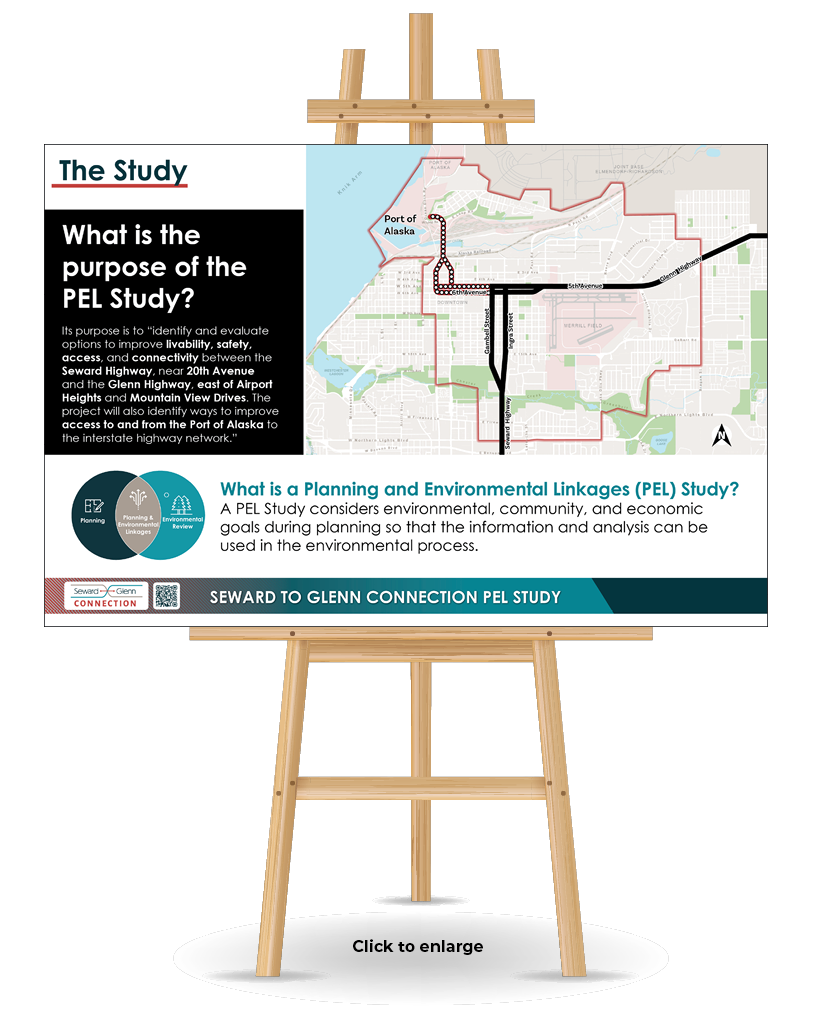
This PEL Study will identify and evaluate improvements to transportation safety, access, connectivity, and livability. The study area generally follows Bragaw Street on the east, Northern Lights Boulevard on the south, C Street on the west, and Joint Base Elmendorf-Richardson on the north. It includes areas where potential transportation improvements could be developed between the Glenn and Seward Highways as well as to and from the Port of Alaska.
What is a PEL?
The purpose of this PEL Study is to “… identify and evaluate options to improve transportation mobility, safety, access, and connectivity between the Seward Highway, near 20th Avenue, and the Glenn Highway, east of Airport Heights and Mountain View Drives. The project will also identify ways to improve access to and from the Port of Alaska to the interstate highway network.”
A Planning and Environmental Linkages (PEL) Study considers environmental, and community, effects during planning so that the information and analysis can be used in later environmental processes.
Purpose & Need
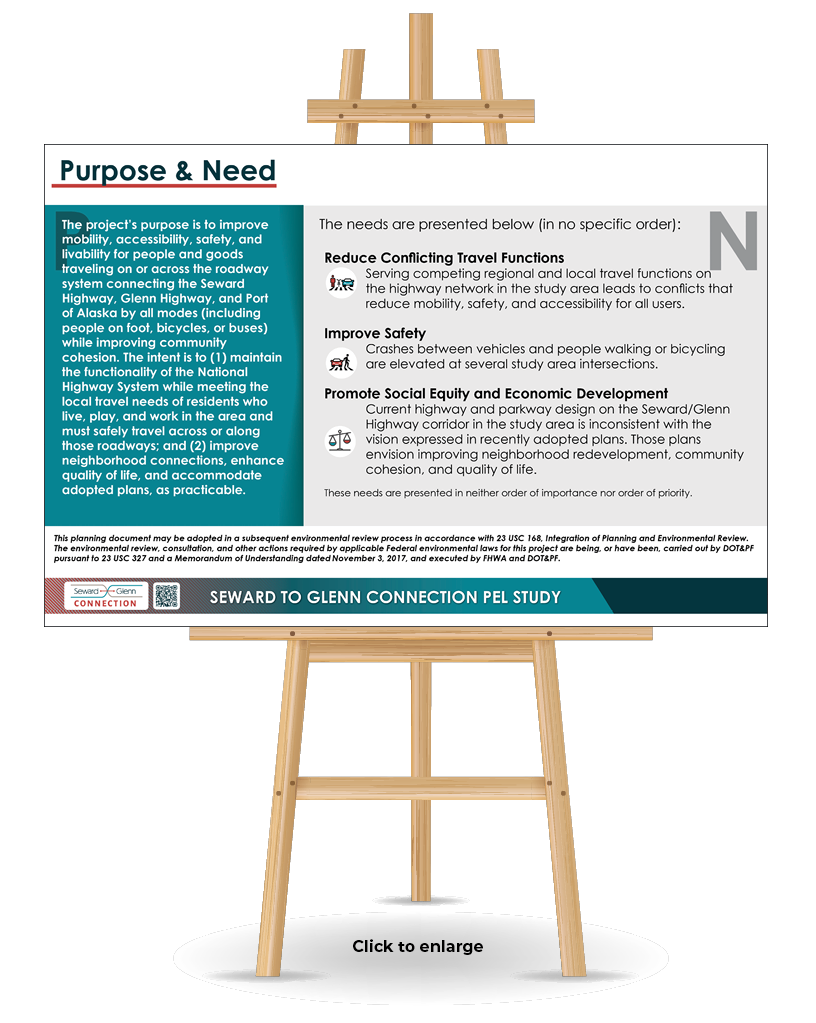
The purpose of this project is to improve mobility, accessibility, safety, and livability for people and goods traveling on or across the roadway system connecting the Seward Highway, Glenn Highway, and Port of Alaska by all modes (including people on foot, bicycles, or buses) while also improving community cohesion. The intent is to (1) maintain the functionality of the National Highway System while meeting the local travel needs of residents who live, play, and work in the area and must safely travel across or along those roadways; and (2) improve neighborhood connections, enhance quality of life, and accommodate adopted plans, as practicable.
The needs of this project are presented below (in no specific order):
Reduce Conflicting Travel Functions:
- Serving competing regional and local travel functions on the highway network in the study area leads to conflicts that reduce mobility, safety, and accessibility for all users.
Improve Safety:
- Crashes for vehicles and people walking and bicycling are elevated at several study area intersections.
Promote Social Equity and Economic Development:
- Current highway and arterial design on the Seward/Glenn Highway corridor in the study area is inconsistent with the vision expressed in recently adopted plans. Those plans envision improving neighborhood redevelopment, community cohesion, and quality of life.

Balancing the Issues & Challenges
Solving the transportation challenges requires balancing several competing interests and needs. The study team created alternatives that attempt to:
- Improve safety
- Reduce regional and local travel conflicts
- Consider the needs of all users (pedestrians, bicyclists, vehicles, and freight)
- Maintain National Highway System (regional) functionality
- Improve the ability to move safely and efficiently when accessing key destinations.
- Improve access between the Port of Alaska and the highway while also reducing neighborhood impacts
- Improve livability by helping reconnect the neighborhood (physically and socially) by removing or separating regional and port traffic from local traffic, improving quality of life, and promoting economic development
- Accommodate ideas from adopted plans.
Solutions should consider the needs of all user groups (pedestrians, bicyclists, local and regional vehicles, and freight).

Project Schedule
The project is currently in Phase 6 of the Planning and Environmental Linkage (PEL) Study process (see schedule graphic to the left). We are seeking public feedback, with a focus on the recommended alternative and draft PEL Study recommendations.
In December 2024, the study team presented the results of the Level 1 screening, which recommended five alternatives to be carried forward for additional analysis. Now, we are presenting the Level 2 screening results and recommendations, and the draft PEL Study report that summarizes the recommendations for public review and feedback.
The Seward to Glenn Connection PEL Study is expected to be finalized in early 2026. This PEL Study identifies transportation recommendations for inclusion in Anchorage’s Metropolitan Transportation Plan as well as subsequent environmental review and design.
Following the PEL Study, a separate environmental analysis would evaluate potential impacts and further refine projects if the PEL Study’s recommendations are adopted.
If you would like to be kept informed of PEL Study progress, please visit the “Contact Us & More Info” section of this online open house and sign up for the email list.

Alternatives Development Process
Ideas for alternatives were collected from public input, obtained through outreach and workshops with city and state representatives and community groups, as well as a review of past plans and studies.
The study team created alternatives to address transportation problems in the corridor. Additional public input was collected as alternatives were screened and refined.
The Alaska Department of Transportation and Public Facilities (DOT&PF) is currently asking for public input on the remaining, refined alternatives and recommendations. These have been evaluated against purpose and need factors, right-of-way impacts, and environmental impacts to identify the recommendations that are presented in the draft PEL Study.

Alternatives Update
In December 2024, the study team presented refined alternatives and initial (Level 1) screening results to the public. Based on what we heard and screening results, the team:
Eliminated
- All freeway alternatives
- Parkway Alternative D
Advanced for further evaluation:
Alternatives
Click on the buttons below to view each alternative or choose the tabs to the left.

Alternative 1: No Action
A No Action alternative is required under the National Environmental Policy Act (NEPA) as a baseline for comparison to test what would happen if no changes were to occur on the connection between the Seward and Glenn Highways.
Under the No Action alternative:
- Gambell and Ingra Streets would remain four lanes each (no lane or speed reductions; no Fairview Main Street)
- 5th Avenue would remain six lanes in front of Merrill Field
- The 5th and 6th Avenue one-way pair would remain three lanes in each direction
- No improvements would be made to Hyder Street (no Fairview Greenway, no pedestrian boulevard)
- All other adopted projects in the Metropolitan Transportation Plan (MTP) are assumed to occur

1. 5th Avenue Existing

2. Gambell Street Existing

3. Ingra Street Existing

4. Glenn Highway Existing

Alternative 2: 2050 MTP
Alternative 2: 2050 MTP is the adopted transportation plan guiding transportation improvements in Anchorage.
The 2050 MTP alternative includes lane reductions on 5th and 6th Avenues, and Gambell and Ingra Streets, with a pedestrian boulevard and trail connection along Hyder Street. Ingra and Gambell Streets would become three-lane, one-way streets, and 5th Avenue would become a four-lane arterial street. In the space where the travel lanes are removed, bike or pedestrian improvements would be made. Hyder Street would become a pedestrian-focused facility.
If none of the recommendations from this study are implemented, the 2050 Metropolitan Transportation Plan (MTP) would be the planned path forward.
Alternative Features

1. 5th Ave – 4-Lane Arterial

2. Ingra and Gambell 3-Lane, 1-Way

3. Pedestrian Blvd

4. Trail Connection

Alternative 3: Transit Focus
Alternative 3: Transit Focus is intended to enhance the 2050 MTP to improve transit service as a means of solving the problems identified in the project’s purpose and need. Specifically, it aims to reduce regional-local traffic conflicts, improve safety and livability, and support the community’s vision for transformed streets through Fairview while also maintaining the functionality of the Interstate Highway System. This alternative tests the feasibility of solving the problems (including advancement of a two-lane, two-way Fairview Main Street), without building a new arterial road connection.
See the Alternative 3 Transit Routes poster for details on new transit routes tested in Alternative 3. In summary, the alternative includes:
- A series of new and/or expanded transit routes that build upon the already existing and planned routes
- Expanded service frequency on several existing routes
- Elimination of fares
- Increased rideshare program use
- Microtransit
- Land use incentives
- Telework and other demand management strategies

1. 5th Ave – 6-Lane Arterial with HOV
2. Ingra 3-Lane, 2-Way

3. Gambell Main St 2-Lane, 2-Way
4. Pedestrian Blvd
5. Trail Connection

Alternative 3: Transit Routes
This poster details the supplemental transit routes analyzed for Alternative 3: Transit Focus. These routes are additive to the existing and planned routes.
Transit routes detailed on the map include:
- Glenn Highway High Occupancy Vehicle (HOV) Lanes
- Convert one lane in each direction to HOV for carpooling and bus priority
Bus Service Enhancements
- Maintain Matanuska-Susitna Borough (MSB)–Downtown service; increase frequency to every 30 minutes
- Create a new MSB–Airport route via UMED and Midtown
- Upgrade Route 92 (Eagle River to Downtown/Midtown)
- Develop a new express service from Dimond Center to Midtown/Downtown via C Street
- Develop rapid transit connecting Downtown, Midtown, and UMED
The study team additionally considered other enhancements:
- Develop microtransit zones
- Eliminate fares system-wide
- Expand rideshare
- Add nonmotorized and transit-supportive features
- Promote telework, telemedicine, and e-learning
- Encourage higher-density development per the Municipality of Anchorage’s 2040 Land Use Plan

Alternative 4: Ingra Tunnel
Alternative 4: Ingra Tunnel, a refinement of Parkway Alternative AB, roughly follows the previous Parkway Alternative AB alignment through Fairview, in a tunnel underneath Ingra Street. Refinements include:
- Routing on a four-lane parkway along a reconstructed 3rd Avenue (previously north of 3rd Avenue) to reduce ROW and cost impacts
- Eliminating the tunnel under Commercial and Mountainview Drives (previously used surface street connections) to reduce costs
- Modified interchange at Airport Heights Drive and the Glenn Highway (to reduce costs)
As previously:
- Operating Ingra Street above the tunnel without conflicts with regional traffic.
- Reconstructing Gambell and Ingra Streets as main streets to align with the community’s vision.

1. Ingra Tunnel

Roundabout Example
4. Gambell Main St – 2-Lane, 2-Way
2. 5th Ave – 4-Lane Arterial
5. Pedestrian Blvd

3. Ingra (above tunnel) 3-Lane, 2-Way
6. Trail Connection

Click the link below to view specific highlights for Alternative 5.
Alternative 5: Fairview Bypass
Alternative 5: Fairview Bypass, formerly named Parkway Alternative C, roughly follows the previous Parkway Alternative C1 and C2 alignments along 15th Avenue and along the southeastern side of Merrill Field. Refinements include:
- A change from a bored tunnel under South Fairview to a depressed roadway with a cut-and-cover park, enhanced bridges, nonmotorized crossing, and other neighborhood connectivity improvements, thereby reducing costs
- Reduction in lanes on 15th Avenue
- A modified interchange at Airport Heights Drive and the Glenn Highway to reduce costs
The recommended solution is more than just one project; it is a group of projects that create a subarea plan, which includes regional connections, accommodation, enhancement of MTP 2050 projects, and transit. Together these projects ranked best for regional mobility, safety, and livability.
1. Trail Connection
4. Gambell Main St – 2-Lane, 2-Way
Roundabout Example
5. Pedestrian Blvd
2. 5th Ave – 4-Lane Arterial

6.Enhanced Bridge Example
3. Ingra (above tunnel) 3-Lane, 2-Way

7. Cut-and-cover Example

Recommended Alternative 5: Fairview Bypass
Alternative Analysis Summary
Through the alternatives screening, community input, and planning process, the study team has recommended that Alternative 5: Fairview Bypass be moved forward for analysis. Based on the screening criteria, this alternative provides the most benefit to the community within the area constraints and community needs.
These benefits are anticipated to reduce the impact of traffic from the current connection by routing most users around the neighborhood. This alternative would additionally aid community cohesion, nonmotorized transportation, and neighborhood development.
There are many needs within the area, and this is our best recommendation for meeting as many needs as possible while balancing all the issues and challenges.

Implementation Plan for the Recommended Alternative
The study team has analyzed what implementing a suburban plan like this would entail. Several key segments and features would need to be phased to keep the community and roads functioning during these changes. This plan also provides flexibility to allow for community priorities and funding to help inform the order in which each project is constructed.
This plan represents the project team’s recommendation based on the constructability, traffic, cost estimates and benefits for how to phase implementation of the recommended projects.

2050 Traffic Diversion
A key consideration when planning for traffic is determining whether people use a new roadway or project enough to achieve the project goals. Alleviating traffic and improving safety through Fairview is a key consideration. The project team endeavored to do that without exacerbating traffic impacts in other neighborhoods.
Through our forecasting efforts, the study team found that a new regional parkway connection would best Meet the study’s purpose and need while reducing traffic impacts to other existing streets and neighborhoods.
View the detailed traffic modeling report appended to the Level 2 Screening and Recommendations report on the project’s library sewardglennconnection.com.

2050 Vehicle Diversion Impacts
To help in decision making, the study team has forecast where traffic is anticipated to go if the alternatives were to be implemented.
Reducing capacity on Gambell and Ingra Streets or Fifth Avenue without a place for that regional traffic to go would redirect it to other roads. We want to avoid increasing vehicle traffic impacts on other neighborhoods.
The varying levels of anticipated traffic impacts from the different alternatives are shown in this poster. Alternative 5: Fairview Bypass stands out as having substantial decreases on many area roads while also reducing traffic levels in Fairview. This is a key desired outcome to improve the livability in Fairview, to foster neighborhood redevelopment, community cohesion, and quality of life. Alternatives 2 and 3 (and, to a lesser degree, Alternative 4) caused notable traffic diversion to other neighborhoods which contributed to those alternatives not being recommended.

Screening Summary
Key screening categories include:
- Safety – looks at the number of crashes and conflict points.
- Mobility and accessibility – considers nonmotorized use, the port, and vehicles.
- Livability – considers community plans, residents and businesses, pedestrian infrastructure, and truck traffic.
- Environmental impacts – considers noise, water and air quality, historical and archaeological preservation, energy, and construction impacts.
- Technical feasibility – can it be built?
- Economic feasibility – can it be funded?
This chart represents a summary of some of the key screening results. There are a considerable number of other metrics. See the full report in the project’s library at sewardglennconnection.com for detailed screening data.

Next Steps
As we move toward these final steps of the PEL Study, the study team will be taking public comments that can help shape the final study recommendations.
However, this is just the start. Each of the projects that come out of our recommendations will still need to be adopted in Anchorage’s Metropolitan Transportation Plan, get funded, and then undergo additional environmental analysis and engineering before they are constructed.
We don’t currently know the specifics of how, when or even if each project recommendation will advance., There will be opportunities for you to stay engaged as each phase of the implementation process will have community engagement.

Contact Us & More Information
Thank you for visiting our Online Open House!
The project team is taking comments on two draft reports which you can download here:
- Level 2 Screening and Recommendations Report
- Draft Seward Highway-Glenn Highway Connection Planning Environmental Linkage Study
You can also download:
-
Presentation pdf download
-
Posters pdf download (large file)
The public comment period is from October 21, 2025, to November 21, 2025.
Please submit your comments today through the following methods:
- Online: sewardglennconnection.com
- By email: info@sewardglennconnection.com
- By phone: (907) 206-2289
Seward to Glenn Connection Planning and Environmental Linkages (PEL) Study
Online Open House #6 Mobile Site
Seward to Glenn Connection Planning and Environmental Linkages (PEL) Study
Online Open House #6 Mobile
Note this site is best viewed on a laptop or desktop computer at 100% view.
Welcome and thank you for participating in the final Seward to Glenn Connection Planning and Environmental Linkages (PEL) Study Public Online Open House, hosted by the Alaska Department of Transportation and Public Facilities (DOT&PF) and Anchorage Metropolitan Area Transportation Solutions (AMATS).
The purpose of this online open house is to share the materials that were presented at the Tuesday, October 21, 2025, in-person public meeting, which focused on design alternatives. This online platform is open from October 21 through November 21, 2025.
Feedback
Your feedback is important to us! To provide feedback, you may visit the Contact Us & More Information section of this Online Open House or visit the contact us page on our website at sewardglennconnection.com.
Documents
You will also find materials shared at the in-person meeting linked on the project website at sewardglennconnection.com.
Navigating This Site
This is the text only version of the October 21, 2025 Public Meeting for the Seward Glenn Connection PEL. If you need any additional assistance navigating this open house website, please contact info@sewardglennconnection.com or (907) 206-2289.
Habla español? | Koj hais lus hmoob? | E te tautala samoa?
(907) 206-2289 | info@sewardglennconnection.com

Welcome - Project Introduction
Welcome to the Seward to Glenn Connection Planning and Environmental Linkages (PEL) Study Open House for Public Meeting #6: Draft Alternatives.
All materials presented at the Tuesday, October 21, 2025, in-person Public Open House can be viewed within this interactive website. A public comment period will run from October 21, 2025, through November 21, 2025.
The Alaska Department of Transportation and Public Facilities (DOT&PF), Central Region, is conducting a PEL Study to identify and evaluate options to improve livability, regional travel between the Seward and Glenn Highways, and local travel within the surrounding neighborhoods. The project will also identify ways to improve access between the Port of Alaska and the highway network.
Your input is critical to the success of the study. We hope you will take time to review the alternatives and share your feedback.
You may download PDF documents of project-related materials listed below. These documents are either downloadable PDF documents or weblinks. Adobe Reader is required to view the PDF documents. You may obtain a free copy at https://get.adobe.com/reader.
Project Fact Sheet (PDF download)
FAQs (PDF download)
Meeting Materials

Study Area
This PEL Study will identify and evaluate improvements to transportation safety, access, connectivity, and livability. The study area generally follows Bragaw Street on the east, Northern Lights Boulevard on the south, C Street on the west, and Joint Base Elmendorf-Richardson on the north. It includes areas where potential transportation improvements could be developed between the Glenn and Seward Highways as well as to and from the Port of Alaska.
What is a PEL?
The purpose of this PEL Study is to “… identify and evaluate options to improve transportation mobility, safety, access, and connectivity between the Seward Highway, near 20th Avenue, and the Glenn Highway, east of Airport Heights and Mountain View Drives. The project will also identify ways to improve access to and from the Port of Alaska to the interstate highway network.”
A Planning and Environmental Linkages (PEL) Study considers environmental, and community, effects during planning so that the information and analysis can be used in later environmental processes.

Purpose and Need
The purpose of this project is to improve mobility, accessibility, safety, and livability for people and goods traveling on or across the roadway system connecting the Seward Highway, Glenn Highway, and Port of Alaska by all modes (including people on foot, bicycles, or buses) while also improving community cohesion. The intent is to (1) maintain the functionality of the National Highway System while meeting the local travel needs of residents who live, play, and work in the area and must safely travel across or along those roadways; and (2) improve neighborhood connections, enhance quality of life, and accommodate adopted plans, as practicable.
The needs of this project are presented below (in no specific order):
Reduce Conflicting Travel Functions:
- Serving competing regional and local travel functions on the highway network in the study area leads to conflicts that reduce mobility, safety, and accessibility for all users.
Improve Safety:
- Crashes for vehicles and people walking and bicycling are elevated at several study area intersections.
Promote Social Equity and Economic Development:
- Current highway and arterial design on the Seward/Glenn Highway corridor in the study area is inconsistent with the vision expressed in recently adopted plans. Those plans envision improving neighborhood redevelopment, community cohesion, and quality of life.

Balancing the Issues & Challenges
Solving the transportation challenges requires balancing several competing interests and needs. The study team created alternatives that attempt to:
- Improve safety
- Reduce regional and local travel conflicts
- Consider the needs of all users (pedestrians, bicyclists, vehicles, and freight)
- Maintain National Highway System (regional) functionality
- Improve the ability to move safely and efficiently when accessing key destinations.
- Improve access between the Port of Alaska and the highway while also reducing neighborhood impacts
- Improve livability by helping reconnect the neighborhood (physically and socially) by removing or separating regional and port traffic from local traffic, improving quality of life, and promoting economic development
- Accommodate ideas from adopted plans.
Solutions should consider the needs of all user groups (pedestrians, bicyclists, local and regional vehicles, and freight).

Project Schedule
The project is currently in Phase 6 of the Planning and Environmental Linkage (PEL) Study process (see schedule graphic to the left). We are seeking public feedback, with a focus on the recommended alternative and draft PEL Study recommendations.
In December 2024, the study team presented the results of the Level 1 screening, which recommended five alternatives to be carried forward for additional analysis. Now, we are presenting the Level 2 screening results and recommendations, and the draft PEL Study report that summarizes the recommendations for public review and feedback.
The Seward to Glenn Connection PEL Study is expected to be finalized early 2026. This PEL Study identifies transportation recommendations for inclusion in Anchorage’s Metropolitan Transportation Plan as well as subsequent environmental review and design.
Following the PEL Study, a separate environmental analysis would evaluate potential impacts and further refine projects if the PEL Study’s recommendations are adopted.
If you would like to be kept informed of PEL Study progress, please visit the "Contact Us & More Info" section of this online open house and sign up for the email list.

Alternatives Development Process
Ideas for alternatives were collected from public input, obtained through outreach and workshops with city and state representatives and community groups, as well as a review of past plans and studies.
The study team created alternatives to address transportation problems in the corridor. Additional public input was collected as alternatives were screened and refined.
The Alaska Department of Transportation and Public Facilities (DOT&PF) is currently asking for public input on the remaining, refined alternatives and recommendations. These have been evaluated against purpose and need factors, right-of-way impacts, and environmental impacts to identify the recommendations that are presented in the draft PEL Study.

Alternatives Update
In December 2024, the study team presented refined alternatives and initial (Level 1) screening results to the public. Based on what we heard and screening results, the team:
Eliminated (due to significant social, environmental, and historical resource impacts):
- All freeway alternatives
- Parkway Alternative D
Advanced for further evaluation:
- Alternative 1: No Action
- Alternative 2: 2050 MTP
- Alternative 3: Transit Focus (formerly MTP Plus)
- Alternative 4: Ingra Tunnel (formerly Parkway Alternative AB)
- Alternative 5: Fairview Bypass (formerly Parkway Alternative C)
Alternative 1: No Action
A No Action alternative is required under the National Environmental Policy Act (NEPA) as a baseline for comparison to test what would happen if no changes were to occur on the connection between the Seward and Glenn Highways.
Under the No Action alternative:
- Gambell and Ingra Streets would remain four lanes each (no lane or speed reductions; no Fairview Main Street)
- 5th Avenue would remain six lanes in front of Merrill Field
- The 5th and 6th Avenue one-way pair would remain three lanes in each direction
- No improvements would be made to Hyder Street (no Fairview Greenway, no pedestrian boulevard)
- All other adopted projects in the Metropolitan Transportation Plan (MTP) are assumed to occur
Alternative 2: 2050 MTP
Alternative 2: 2050 MTP is the adopted transportation plan guiding transportation improvements in Anchorage.
The 2050 MTP alternative includes lane reductions on 5th and 6th Avenues, and Gambell and Ingra Streets, with a pedestrian boulevard and trail connection along Hyder Street. Ingra and Gambell Streets would become three-lane, one-way streets, and 5th Avenue would become a four-lane arterial street. In the space where the travel lanes are removed, bike or pedestrian improvements would be made. Hyder Street would become a pedestrian-focused facility.
If none of the recommendations from this study are implemented, the 2050 Metropolitan Transportation Plan (MTP) would be the planned path forward.
Alternative 3: Transit Focus
Alternative 3: Transit Focus is intended to enhance the 2050 MTP to improve transit service as a means of solving the problems identified in the project’s purpose and need. Specifically, it aims to reduce regional-local traffic conflicts, improve safety and livability, and support the community’s vision for transformed streets through Fairview while also maintaining the functionality of the Interstate Highway System. This alternative tests the feasibility of solving the problems (including advancement of a two-lane, two-way Fairview Main Street), without building a new arterial road connection.
See the Alternative 3 Transit Routes poster for details on new transit routes tested in Alternative 3. In summary, the alternative includes:
- A series of new and/or expanded transit routes that build upon the already existing and planned routes
- Expanded service frequency on several existing routes
- Elimination of fares
- Increased rideshare program use
- Microtransit
- Land use incentives
- Telework and other demand management strategies
Alternative 3: Transit Routes
This poster details the supplemental transit routes analyzed for Alternative 3: Transit Focus. These routes are additive to the existing and planned routes.
Transit routes detailed on the map include:
- Glenn Highway High Occupancy Vehicle (HOV) Lanes
- Convert one lane in each direction to HOV for carpooling and bus priority
Bus Service Enhancements
- Maintain Matanuska-Susitna Borough (MSB)–Downtown service; increase frequency to every 30 minutes
- Create a new MSB–Airport route via UMED and Midtown
- Upgrade Route 92 (Eagle River to Downtown/Midtown)
- Develop a new express service from Dimond Center to Midtown/Downtown via C Street
- Develop rapid transit connecting Downtown, Midtown, and UMED
The study team additionally considered other enhancements:
- Develop microtransit zones
- Eliminate fares system-wide
- Expand rideshare
- Add nonmotorized and transit-supportive features
- Promote telework, telemedicine, and e-learning
- Encourage higher-density development per the Municipality of Anchorage’s 2040 Land Use Plan
Alternative 4: Ingra Tunnel
Alternative 4: Ingra Tunnel, a refinement of Parkway Alternative AB, roughly follows the previous Parkway Alternative AB alignment through Fairview, in a tunnel underneath Ingra Street. Refinements include:
- Routing on a four-lane parkway along a reconstructed 3rd Avenue (previously north of 3rd Avenue) to reduce ROW and cost impacts
- Eliminating the tunnel under Commercial and Mountainview Drives (previously used surface street connections) to reduce costs
- Modified interchange at Airport Heights Drive and the Glenn Highway (t reduce costs)
- As previously:
- Operating Ingra Street above the tunnel without conflicts with regional traffic.
- Reconstructing Gambell and Ingra Streets as main streets to align with the community’s vision.
- Alternative 5: Fairview Bypass
- Alternative 5: Fairview Bypass, formerly named Parkway Alternative C, roughly follows the previous Parkway Alternative C1 and C2 alignments along 15th Avenue and along the southeastern side of Merrill Field. Refinements include:
- A change from a bored tunnel under South Fairview to a depressed roadway with a cut-and-cover park, enhanced bridges, nonmotorized crossing, and other neighborhood connectivity improvements, thereby reducing costs
- Reduction in lanes on 15th Avenue
- A modified interchange at Airport Heights Drive and the Glenn Highway to reduce costs
The recommended solution is more than just one project; it is a group of projects that create a subarea plan, which includes regional connections, accommodation, enhancement of MTP 2050 projects, and transit. Together these projects ranked best for regional mobility, safety, and livability.
Alternative 5: Fairview Bypass
Alternative 5: Fairview Bypass, formerly named Parkway Alternative C, roughly follows the previous Parkway Alternative C1 and C2 alignments along 15th Avenue and along the southeastern side of Merrill Field. Refinements include:
- A change from a bored tunnel under South Fairview to a depressed roadway with a cut-and-cover park, enhanced bridges, nonmotorized crossing, and other neighborhood connectivity improvements, thereby reducing costs
- Reduction in lanes on 15th Avenue
- A modified interchange at Airport Heights Drive and the Glenn Highway to reduce costs
The recommended solution is more than just one project; it is a group of projects that create a subarea plan, which includes regional connections, accommodation, enhancement of MTP 2050 projects, and transit. Together these projects ranked best for regional mobility, safety, and livability.

Recommended Alternative 5: Fairview Bypass Alternative Analysis Summary
Through the alternatives screening, community input, and planning process, the study team has recommended that Alternative 5: Fairview Bypass be moved forward for analysis. Based on the screening criteria, this alternative provides the most benefit to the community within the area constraints and community needs.
These benefits are anticipated to reduce the impact of traffic from the current connection by routing most users around the neighborhood. This alternative would additionally aid community cohesion, nonmotorized transportation, and neighborhood development.
There are many needs within the area, and this is our best recommendation for meeting as many needs as possible while balancing all the issues and challenges.

Implementation Plan for the Recommended Alternative
The study team has analyzed what implementing a suburban plan like this would entail. Several key segments and features would need to be phased to keep the community and roads functioning during these changes. This plan also provides flexibility to allow for community priorities and funding to help inform the order in which each project is constructed.
This plan represents the project team’s recommendation based on the constructability, traffic, cost estimates and benefits for how to phase implementation of the recommended projects.

2050 Traffic Diversion
A key consideration when planning for traffic is determining whether people use a new roadway or project enough to achieve the project goals. Alleviating traffic and improving safety through Fairview is a key consideration. The project team endeavored to do that without exacerbating traffic impacts in other neighborhoods.
Through our forecasting efforts, the study team found that a new regional parkway connection would best Meet the study’s purpose and need while reducing traffic impacts to other existing streets and neighborhoods.
View the detailed traffic modeling report appended to the Level 2 Screening and Recommendations report on the project’s library sewardglennconnection.com.

2050 Vehicle Diversion Impacts
To help in decision making, the study team has forecast where traffic is anticipated to go if the alternatives were to be implemented.
Reducing capacity on Gambell and Ingra Streets or Fifth Avenue without a place for that regional traffic to go would redirect it to other roads. We want to avoid increasing vehicle traffic impacts on other neighborhoods.
The varying levels of anticipated traffic impacts from the different alternatives are shown in this poster. Alternative 5: Fairview Bypass stands out as having substantial decreases on many area roads while also reducing traffic levels in Fairview. This is a key desired outcome to improve the livability in Fairview, to foster neighborhood redevelopment, community cohesion, and quality of life. Alternatives 2 and 3 (and, to a lesser degree, Alternative 4) caused notable traffic diversion to other neighborhoods which contributed to those alternatives not being recommended.

Level 2 Screening Summary
Key screening categories include:
- Safety – looks at the number of crashes and conflict points.
- Mobility and accessibility – considers nonmotorized use, the port, and vehicles.
- Livability – considers community plans, residents and businesses, pedestrian infrastructure, and truck traffic.
- Environmental impacts – considers noise, water and air quality, historical and archaeological preservation, energy, and construction impacts.
- Technical feasibility – can it be built?
- Economic feasibility – can it be funded?
This chart represents a summary of some of the key screening results. There are a considerable number of other metrics. See the full report in the project’s library at sewardglennconnection.com for detailed screening data.

Next Steps
As we move toward these final steps of the PEL Study, the study team will be taking public comments that can help shape the final study recommendations.
However, this is just the start. Each of the projects that come out of our recommendations will still need to be adopted in Anchorage’s Metropolitan Transportation Plan, get funded, and then undergo additional environmental analysis and engineering before they are constructed.
We don’t currently know the specifics of how, when or even if each project recommendation will advance., There will be opportunities for you to stay engaged as each phase of the implementation process will have community engagement.

Contact Us & More Information
Thank you for visiting our Online Open House!
The project team is taking comments on two draft reports which you can download here:
- Level 2 Screening and Recommendations Report
- Draft Seward Highway-Glenn Highway Connection Planning Environmental Linkage Study
You may also download:
-
Presentation pdf download
-
Posters pdf download (large file)
The public comment period is from October 21, 2025, to November 21, 2025.
Please submit your comments today through the following methods:
- Online: sewardglennconnection.com
- By email: info@sewardglennconnection.com
- By phone: (907) 206-2289